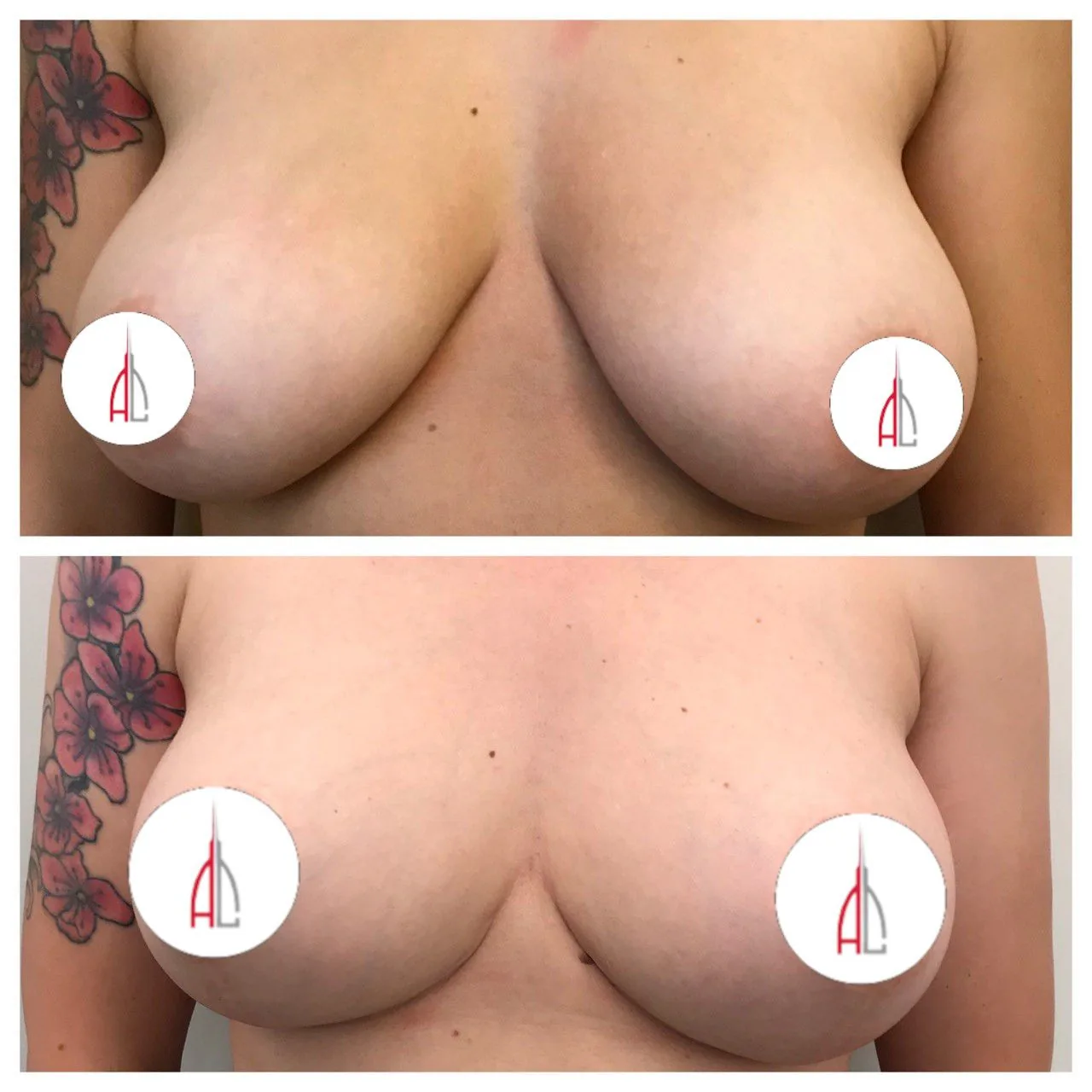
A mastopexy, also called a breast lift, corrects sagging, loss of volume and the shape of the breast.
These before and after photos show real patients of Dr Giulio Maria Maggi, published with their written consent. They help you understand the options and set realistic goals.

In short. A breast lift raises and reshapes a sagging or deflated breast, after pregnancy, weight loss, with time or by predisposition. It can be done with your own breast tissue only, or with the addition of an implant or fat grafting when volume is also needed. The technique, and therefore the scars, depend on how much the breast has dropped. It is performed under general anaesthesia, with one night in the clinic, in Turin, Italy.
When the breast drops (breast ptosis) and loses volume, other changes often follow: the areolas may widen and the skin may stretch, becoming thin and less elastic. A deflated, sagging or poorly shaped breast may also be present from the earliest stages of development.
With a breast lift, a low nipple and areola can be raised, large areolas can be reduced and made more proportionate, the breast gland can be lifted into a better position, and the whole breast can be firmed and reshaped.
Sagging is often part of ageing, but other factors play a role, for example smoking, several pregnancies or major changes in weight.
Restoring volume in the upper part of the breast (above the nipple) can often be done with the existing breast tissue. When the loss of volume is more significant, particularly after pregnancy or weight loss, fat grafting or an implant may be indicated to restore it (augmentation mastopexy). In some cases an implant alone is enough; when the position, tone and shape of the breast need significant improvement, a mastopexy is usually the better choice. A mastopexy lifts and reshapes the breast but does not add volume: when more volume is wanted, an implant or fat grafting is added. A breast that is too large and heavy is a different case: it needs a breast reduction (page in Italian).
Sagging is usually classified by the position of the nipple compared with the fold under the breast (Regnault classification):
| Type | What it means |
|---|---|
| Grade I (mild) | The nipple is at the level of the fold under the breast. |
| Grade II (moderate) | The nipple is below the fold, but still above the lowest part of the breast. |
| Grade III (severe) | The nipple is well below the fold and points downwards, at the lowest part of the breast. |
| Glandular ptosis (pseudoptosis) | The nipple is above the fold, but the breast tissue has dropped below it. |
Other factors also guide the choice of technique: the elasticity of the skin, the size of the areola, the density of the breast tissue, the overall shape of the breast and how deflated it is.
I always choose the approach with the shortest incisions that can still give a good result in your case.
| Technique | Scar | When I use it |
|---|---|---|
| Periareolar mastopexy ("doughnut") | Only around the areola. | Mild sagging; sometimes moderate sagging when an implant is also used. |
| Circumvertical mastopexy ("lollipop", short scar) | Around the areola and a vertical line below it. | Moderate sagging, when the breast also needs reshaping, lifting and more projection. |
| Wise-pattern mastopexy ("inverted T") | Around the areola, a vertical line and a line in the fold under the breast. | Severe sagging and loss of volume, when more lift is needed. |
| Augmentation mastopexy | As for the lift chosen. | Any lift combined with a breast implant, to restore volume in the upper part of the breast. |
About two weeks before surgery you have a full pre-operative visit: you receive the list of things to do and avoid, the prescriptions for the medicines to take after surgery and the routine blood tests, plus any breast imaging appropriate for your age and history. It is also the time for any remaining questions.
The breast lift is performed under general anaesthesia given by a specialist anaesthetist, and takes about three hours. You spend the first night in the clinic and go home the next morning, once you are fully awake and comfortable; you can take a taxi, and you do not need anyone to accompany you.
| When | What |
|---|---|
| 3 to 5 days | Drains, if used, are removed. No stitches need to be removed: they are under the skin and absorbable. |
| 4 to 7 days | Light work may be possible after four or five days; I usually advise a week off work and strenuous activity. Light exercise (walking, treadmill, stationary bike) from five to seven days. |
| First weeks | You wear a special post-operative bra day and night, then a sports bra. |
| 3 to 4 weeks | Regular bras and swimwear. More vigorous exercise from three weeks. |
| About 6 weeks | Chest exercises, if implants were used. |
| About 12 weeks | The breasts settle into their final shape. |
I see you several times at the clinic in the first two weeks after surgery, and then periodically until the end of the first year.
If you live abroad: plan to stay in or near Turin for at least the first two weeks of check-ups, and until I confirm you are ready to travel. See also International patients.
A breast lift is a surgical operation and has risks, which we discuss together at the consultation: among them haematoma, delayed healing, changes in nipple sensation, asymmetry and scars more visible than expected. If an implant is used, its own risks are added (see breast augmentation). Over the years, pregnancy, weight changes and ageing can make the breast drop again.
“I decided to have a mastopexy because my breasts sagged after I lost 35 kilos. At the first visit the doctor was immediately very understanding, empathetic and clear; he answered all my doubts and questions as well as possible and planned the right operation for me. […] Recovery was very fast: I only had some discomfort in the first week, but I was always able to carry on with my normal activities without any problem. Three weeks after the operation my breasts already look wonderful, completely natural […]”
— Giulia Z.
“I will always be grateful to Dr Maggi for his humanity, competence and professionalism. Turning to him, I knew I was in good hands. He was able to recommend the right operation for me, which gave me back my beauty and my confidence! Thanks also to all the staff, especially Veronica, always helpful and kind. Heartfelt thanks.”
— Lidia, Alessandria
Real patient reviews, translated faithfully from Italian; cuts are marked […]. The original Italian reviews are on the testimonials page and on GuidaEstetica.
The cost depends on the technique, on whether an implant or fat grafting is added and on the hospital stay. Because every case is different, I define it after the consultation, in a personalised written quote that also shows the first available date for surgery.
Under general anaesthesia given by a specialist anaesthetist. The operation takes about three hours, and you spend the first night in the clinic.
Light exercise (walking, treadmill, stationary bike) from five to seven days; more vigorous exercise from three weeks; chest exercises after about six weeks if implants were used.
No: the stitches are placed under the skin and are absorbable. Drains, if used, are removed three to five days after surgery.
Written and medically reviewed by Dr Giulio Maria Maggi, plastic surgeon (Turin Medical Board no. 20595, AICPE member) — last reviewed:
Dr Giulio Maria Maggi - VAT no. 01253320095 - Tax code: MGGGLI68E12A166M | Registered office: Lungo Dora Pietro Colletta 67, 10153 Torino, Italy – Certified email (PEC): giulio.maggi@to.omceo.it | Registered with the Turin Medical Board (Ordine dei Medici di Torino) no. 20595